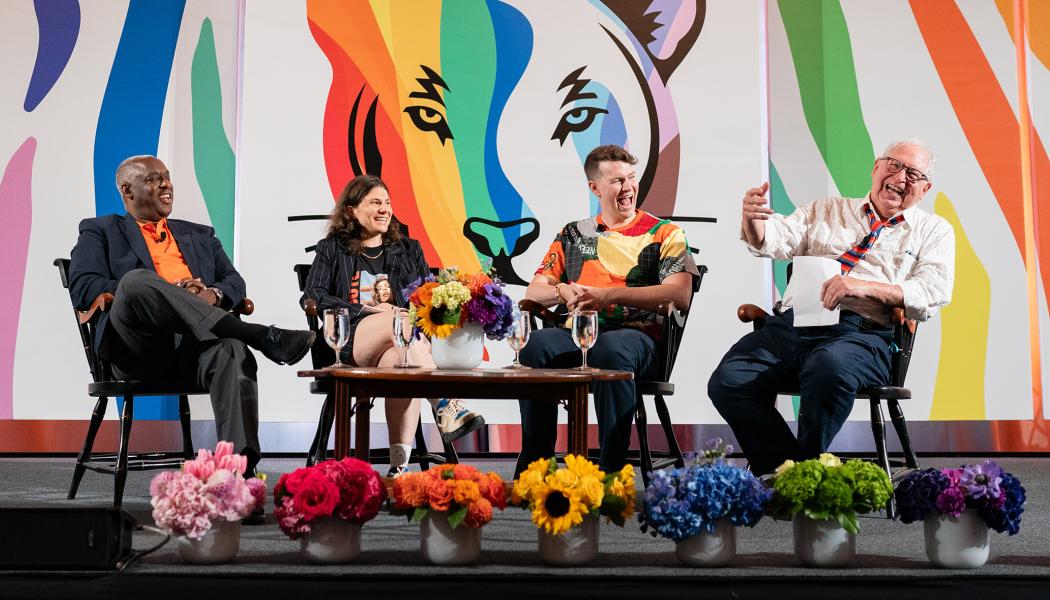
Alumni have fun at an all-affinity reception in Philadelphia in December 2024. Photo by Steve Freeman
Not long after Margaret Sena *17 received her Ph.D., she received a call from an alum asking if she’d be interested in joining the board of the Association of Latino Princeton Alumni (ALPA), one of the University’s alumni affinity groups.
The timing felt right for getting involved. After years focused on family, career and completing her dissertation, adding her name to the ALPA election ballot was the beginning of a new bond with Princeton.
When she was elected to the ALPA board in 2019, Sena knew the volunteer work would be meaningful, but what she didn’t anticipate was how fun it would be, too. The home she found at ALPA expanded to the broader alumni community: “To my great surprise, I made wonderful friends whom I cherish to this day.”
Sena soon took on the role of ALPA vice president and then served as president from 2020 to 2022. After her presidency, she became active in the Association of Graduate Princeton Alumni (APGA) and most recently served on the Alumni Council’s Committee to Nominate Alumni Trustees. In 2025, Sena received the Award for Service to Princeton, recognizing her outstanding volunteer contributions. “ALPA totally changed my involvement with the Alumni Association,” she said. “It totally changed my relationship with the University.”
Sena’s affinity-group experience is inspiring, but her path is not unique. Today, Princeton’s nine alumni affinity groups foster meaningful connections through shared experiences and interests. Together, they help ensure that every alum feels welcomed, represented and connected to the broader Princeton community. They’re communities that are for all alumni, regardless of identity, built one Tiger at a time.
Nine groups, one goal
The goal of Princeton’s affinity groups is to strengthen bonds among alumni and deepen their connection to Princeton. While the goal is the same for every group, the form that takes in terms of programming and events is as varied as the individuals who become members. Affinity groups bring together Tigers of all generations and interests for in-person and online gatherings, on campus and across the globe. Events range from book clubs and coffee chats to professional development workshops and networking. The focus can be food, family or fun, or simply opportunities to support one another.
On-campus gatherings for Reunions often include learning, networking and social events. This past May, for example, the Princeton Veterans Alumni Association (PVETS) hosted an all-service alumni picnic lunch and sponsored a talk by Michael O’Hanlon ’82 *91, the Philip H. Knight Chair in Defense and Strategy at the Brookings Institution, titled “To Dare Mighty Things: U.S. Defense Strategy Since the Revolution.” Queer Princeton Alumni (QPA), celebrating its 40th anniversary, hosted lively events including an evening of jazz and a Saturday night “Ballroom Experience.” Reunions programming for the Princeton University Muslim Alumni Association (PUMAA), which formed in September 2025, included co-sponsoring a very well attended Muslim Life reception.
Regional and virtual events are also vital for affinity group connections. In 2018, Diane Hasling ’79 volunteered to help start a chapter of the Princeton Women’s Network (PWN) in the Princeton area. Hasling cites that group’s book club, which began in 2018 and is still going strong, as an example of the kinds of connections that can happen through events.
“One member, a graduate of the ’70s, told me she hadn’t been to any alumni activities before PWN, and now the book club is an important part of her life,” Hasling said. “During the pandemic, a younger alumna was doing grad schoolwork remotely at her parents‘ home and joined our virtual book club. She stayed with the group when she returned to Boston for school. Several members of our group were able to join her dissertation defense virtually, and we all celebrated her accomplishment.”
Hasling now also serves as chair of the PWN Advisory Council, which supports local PWN chapters and alumnae worldwide. Among other efforts, the council is working to expand the PWN community by sharing more chapter events, photos and news on its TigerNet website and offering virtual events such as last year’s “Our Princeton, Our Time: Three Eras of Women’s Leadership at Princeton” program, which drew attendees from 20 states, Hong Kong, Puerto Rico and Rwanda.
PUMAA’s launch in 2025 relied on regional Ramadan iftars. Through the group’s TigerNet site, alumni could find the gathering nearest them, including one on campus, and reach out to RSVP or ask the host questions. The TigerNet site also included links to join regional WhatsApp groups for additional updates. These inaugural celebrations included more than 200 Muslim alumni.
Affinity group sites on TigerNet regularly showcase upcoming events and provide additional opportunities for alumni connection. PVETS, which is closely aligned with the Alumni and Friends of Princeton ROTC (AAF), has a robust site that includes a history of Princeton’s ROTC, alumni and student spotlights, and annual reports, where all members can review priorities for the year. Seasonal newsletters from PVETS/AAF provide news from campus as well as actionable items to help strengthen the community of military alumni. For example, the fall 2026 newsletter included a call to action to send photos of uniformed alumni for display at the Salute to Service football game.
Social media is another connection point for affinity group alumni. Recent QPA Facebook and Instagram posts have included invitations to a virtual book launch, to a virtual presentation featuring the founders of Families United for Trans Rights (FUTR), and to in-person LGBTQIA+ intercollegiate alumni parties in Los Angeles, New York and San Francisco, in addition to a celebration of International Pronouns Day.
As of last year, current students are able to join affinity groups via TigerNet, providing them insight into alumni engagement. “Students are future alumni, and we are alumni far longer than we are students,” said Micheal Gunter ’14, president of the Association of Black Princeton Alumni (ABPA). “One of my missions as president is to communicate that ABPA is concerned with Black life at Princeton and beyond.”
Meeting alumni where they are, not just physically but emotionally, is important: “ABPA is not just for members who bleed orange,” Gunter said. “Black alumni have frequently felt ostracized or alienated. ABPA is a place where they can express those feelings and challenge those experiences and hopefully create new feelings and enjoy new experiences.”
Keeping the metaphorical tent big for all alumni has been a focus for Jason Gold ’81, former president of the Association of Jewish Princeton Alumni (AJPA). Gold attended the “L’Chaim” conference on campus in 2016, which celebrated 100 years of Jewish life at Princeton. He remembers a conversation one evening looking at a tent next to Alexander Hall. “I turned to somebody and said, ’If you had told me when I was a freshman that I would one day see a tent on campus with hundreds and hundreds of Jewish alums having Shabbat dinner, I would’ve told you that you were tripping,’” he said.
As the most recent past president of AJPA, founded in 2024, his goal was to build that community. “Our constituency is extremely diverse,” he said. “Our group is to embrace all of that diversity.”
Princeton’s affinity group leaders share why these relationships matter
Asian American Alumni Association of Princeton (A4P)
“I am who I am in part due to Princeton, and I say ‘Thank you’ by trying to help Princeton become a better institution, by being a positive influence to younger Tigers through A4P.” — Benny Mah ’82


Meeting people where they are
The affinity groups share a purposeful mission: creating a vibrant and inclusive Princeton community. Princeton’s affinity groups are represented on the University’s Alumni Council: the nine groups work closely with more than 150 regional associations to connect alumni and celebrate diverse experiences. These volunteer-driven groups help alumni remain a part of present-day Princeton and help support the University’s goals and initiatives. The beating heart of the groups lies in simple, meaningful personal connections that are made Tiger by Tiger.
Yolandra “Yollie” Gomez ’88 co-founded Native Alumni of Princeton (NAP) after many years of her own disengagement from the University. She hoped to create a community of support that she wished she had experienced as an undergraduate.
“I didn’t realize till much later how valuable the Princeton experience was for me,” she said. “I saw that in both my professional and personal relationships with people because I experienced things that other people had not experienced who came from my background. That really spurred me on to create the affinity group.”
Creating community and a common cause for current students and alumni was an initial goal for Gomez, as was helping to educate the Princeton community about Native nations. After her tenure as president of NAP, Gomez was elected in 2022 as an Alumni Trustee and completed a four-year term on the Board of Trustees. She continues to stay active in NAP, advocating for events that partner with other affinity groups and promoting regional activities. NAP currently also serves as a key thought partner for Native initiatives at Princeton.
Vivian Ling ’94 had been an active volunteer with the Alumni Schools Committee, but wasn’t yet involved with an affinity group when she decided to attend an A4P Lunar New Year celebration in Boston. The event was in a large and busy restaurant; she volunteered to help guide new arrivals to the group’s table. The following year, they needed an organizer for the same event, and Doug Chin ’83 reached out to her for help. She jumped in.
Ling became the regional organizer for A4P; her core team of volunteers are recent alumni. She believes in meeting people where they are. “Whatever people are already planning to do, we just make it an event,” she said, citing trips to museums, half marathons, picnics, karaoke and summer sailing. “We do a lot of joint events with PWN and other affinity groups. The more, the merrier. All our events are co-sponsored by and advertised through the Princeton Association of New England (PANE) and open to all alumni.”
Ling’s A4P involvement became a path to her own greater engagement. “Because of my A4P involvement, I went back to my first reunion — our class’s 25th. That really prompted me to get engaged with my class.
“I like to think of these involvements in small steps,” she added. “If we are to get people involved, a lot of times, it takes just an initial ask, and then involvement happens incrementally.”
Ling became vice president of PANE this year and spoke at a Boston-area all-alumni event, encouraging others to join Princeton’s affinity groups. “I was not involved with Princeton for so long due to various life-stage reasons but there is always a way back,” she said. “If I could do this, if I could get involved, so can anybody. I encourage everybody else to jump in from wherever they are.”
Join an affinity group: It’s easy as 1-2-3
- Select a group you’d like to join (see list below). All affinity groups are open to all alumni regardless of identity.
- Join through TigerNet, Princeton’s secure, password-protected online alumni community.
- Start connecting with Tigers.
Princeton’s current affinity groups and their founding years
Association of Black Princeton Alumni (ABPA), 1972
Asian American Alumni Association of Princeton (A4P), 1979
Queer Princeton Alumni (QPA), 1986
Association of Latino Princeton Alumni (ALPA), 1989
Princeton Women’s Network, (PWN), 1995
Princeton Veterans Alumni Association (PVETS), 2018
Native Alumni of Princeton (NAP), 2021
Association of Jewish Princeton Alumni (AJPA), 2024
Princeton University Muslim Alumni Association (PUMAA), 2025