Math maestro Terence Tao *96 is solving the world’s puzzles

photo courtesy of UCLA
Terence Tao *96 earned his Ph.D. at Princeton at age 20, but he first visited town when he was 9 years old. In 1985, he flew in from his home in Australia with his father, Billy Tao, a pediatrician, who had managed to arrange an audience for his son at the Institute for Advanced Study (IAF). Billy hoped Enrico Bombieri and Charles Fefferman *69, IAF faculty members who both had won the Fields Medal for achievement in mathematics, might judge what kind of potential his son had.
Young Terence certainly had a promising mind. He scored 760 out of 800 on the math portion of the SAT exam at age 8 and skipped five grades in primary school. By 9, he was taking math classes at Flinders University in Adelaide.
Fefferman, now the Herbert E. Jones, Jr. ’43 University Professor of Mathematics at Princeton, had been a prodigy himself. He entered the University of Maryland at age 12 and at 22 became the youngest full professor in the U.S. at the University of Chicago. He recalls sitting in Bombieri’s office, trying to pose problems that might reveal Tao’s ability to think creatively.
Tao still remembers one puzzle: You are standing on an imaginary flat disc where, as you move closer to the edge, you shrink. In this world, what’s the shortest path from point A to point B?
“He was trying to describe what’s called hyperbolic space, but I didn’t know that at the time,” Tao said. “I liked solving math puzzles, so if someone asked me a math question, I’d just babble on about it. I remember guessing the right answer, and he was impressed.”
The answer isn’t a straight line. It’s an arc, which prevents your legs and steps from shortening too quickly.
“After the session with little Terry, his father asked Bombieri and me: ‘Does this kid have real talent?’” said Fefferman. “If I had said no, that would have been on a very short list of the dumbest mistakes in my life.”
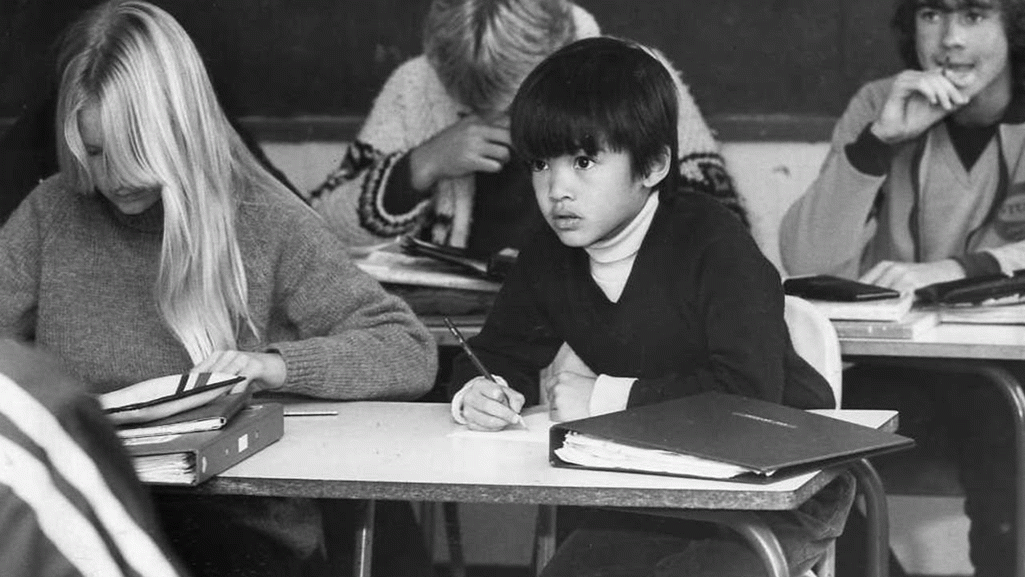
It turns out the experts were right about Terence Tao’s potential. He won the Fields Medal in 2006 for his work in partial differential equations, combinatorics, harmonic analysis and additive number theory. The Fields citation called him “a supreme problem-solver” who “combines sheer technical power, an other-worldly ingenuity for hitting upon new ideas, and a startlingly natural point of view that leaves other mathematicians wondering, ‘Why didn’t anyone see that before?’”
In 2007, Tao won a MacArthur Foundation “Genius” fellowship. He often is called “the Mozart of math” for his inventiveness. (Mozart’s father also famously toted him across the world.) Now 50, Tao is educating a generation of graduate and undergraduate students as a professor of mathematics, the James and Carol Collins Chair in the College of Letters and Sciences at UCLA and the director of special projects at UCLA’s Institute for Pure and Applied Mathematics (IPAM). His research at IPAM helped lead to algorithms that cut MRI scan times by a factor of up to 10.
Tao has shown academic leadership beyond the chalkboard as well. In 2025, he spoke out against federal cuts to university research and educational funding and against changes in U.S. immigration policy that impact foreign students — moves he believes undermine an American strength.
“It is a deliberate dismantling of the institutions, funding, and freedoms that have sustained American science for generations,” he wrote in an online essay. “I speak to this not as a distant observer, but as someone whose entire professional life has been shaped by that ecosystem. ‘Sesame Street’ taught me to count; Carl Sagan’s ‘Cosmos’ inspired a fascination with the natural world.”
On Feb. 21, the arc of Tao’s story will return to Princeton again, where he will receive the James Madison Medal, presented annually to honor a Princeton graduate alum who has had a distinguished career, advanced the cause of graduate education or achieved an outstanding record of public service.
“Terence Tao is one of the most singular thinkers in mathematics. His technical brilliance, exceptional creativity, wide-ranging curiosity, and collaborative spirit have led to multiple pathbreaking discoveries. Sometimes described as the world’s greatest living mathematician, Terry is admired for his humility, generosity, and integrity as well as for his stunning intellectual achievements,” Princeton University President Christopher L. Eisgruber ’83 said in the award announcement.
Tao is looking forward to coming back. “I have fond memories of my time as a graduate student,” he said. “In fact, every time I come back to visit, I mentally feel like a student again. So there may be a little cognitive dissonance this time around, to come as a recipient of an award instead.”
Coming of age at Princeton
Tao’s parents Billy and Grace (a science and math schoolteacher) emigrated from China to Australia in the early 1970s, and Tao was born in 1975. Every child enters the world straining to piece together life’s patterns and rules. Tao became systematic about it quickly, beginning a lifelong search to solve the world’s puzzles. “My earliest memories, I remember being obsessed with numbers,” he said. “My parents told me that at age 2 they caught me trying to teach some older kids how to count.”
Tao and his younger brothers, Trevor and Nigel, close in age, all were gifted. Billy Tao took the boys to conferences for exceptional children. At home, they invented games, putting pieces from unrelated games on a Scrabble board and creating elaborate rules. The local Adelaine Advertiser newspaper featured Tao in a 1983 story with the front-page headline “Tiny Terence, 7, is a High-School Whiz.” “When I was too rowdy as a kid, my parents would give me a math workbook to calm me down,” Tao once said.
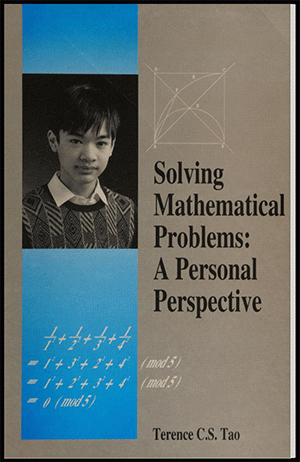
In 1990, at age 15, he wrote his first book, “Solving Mathematical Problems: A Personal Perspective.” He finished college at 16, and after a mentor there advised him to continue his studies abroad, he began at Princeton at 17.
“I came over with my father. He helped set me up for the first week,” Tao said. “I think I had lived away from home for a grand total of one week, so he came to teach me sort of basic things, like how to do laundry and open a bank account.”
He had never seen snow falling. “I remember walking around and thinking there’s something wrong with my vision, because I suddenly see spots in front of my eyes. The spots would land on my jacket and disappear,” Tao said. “We had a big blizzard my second year, and we were snowed in in my apartment in Butler. That was fun.”
But by his fourth year, he was tired of snow and slush. It made riding his bike around campus difficult. And when he left Princeton for summer breaks, it was wintertime back home in Adelaide. (His offers to do postdoctoral study were from M.I.T. and UCLA; he chose sunny Los Angeles).
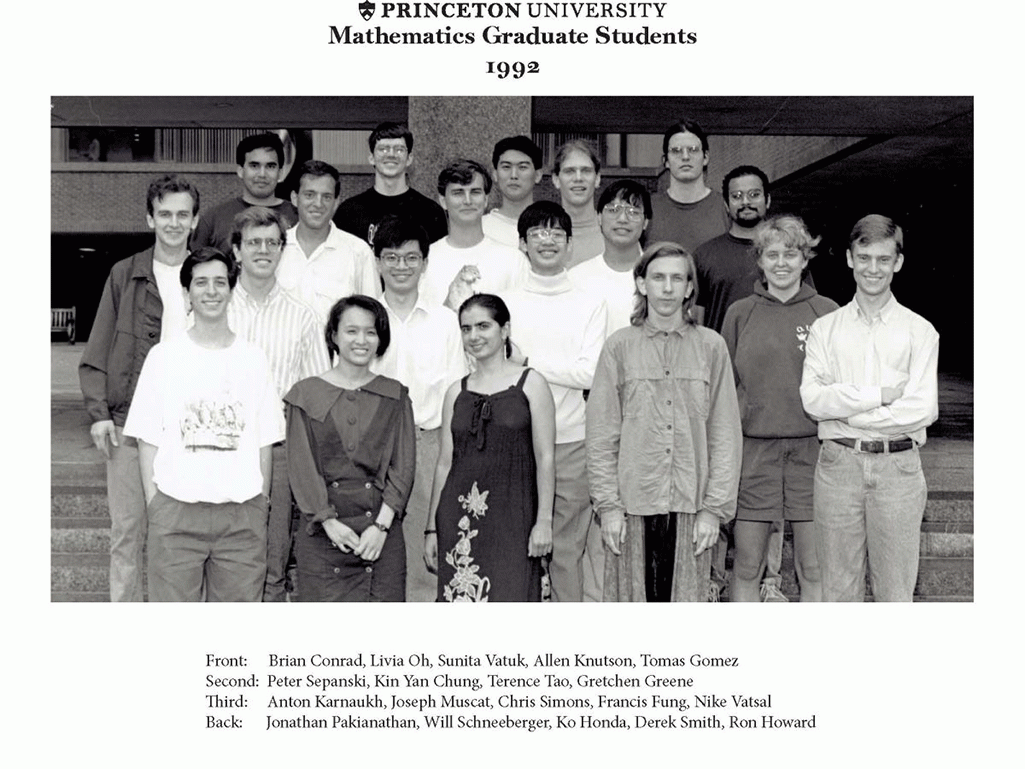
“In many ways, socially, I got kind of the undergraduate experience at Princeton doing my Ph.D. I didn’t really get that experience as an undergraduate because I was five years younger than most of my peers,” Tao said. At Princeton, he went to the bridge club and film club, to videogame and comic book stores. Fellow math grad student Allen Knutson *95, now a math professor at Cornell University with whom Tao has co-authored a paper about Horn’s conjecture, said they did traditional student things: playing foosball, burying a classmate’s car with snow.
It was a heady time for math at Princeton — in 1994, math professor Andrew Wiles produced a proof of Fermat’s Last Theorem, a holy grail that mathematicians had struggled with for 350 years. Tao sometimes was intimidated by the stature of the established scholars around him. One day in 1994, he thought he might revisit the Institute for Advanced Study and try meeting Jean Bourgain, a Fields winner who had just joined IAS. Tao walked to the IAS campus and got to Bourgain’s office door, then was afraid to knock. “I chickened out at the last minute,” he said. They eventually met — and co-authored a paper.
Tao studied under Ph.D. adviser Elias Stein, a math titan who also had been Fefferman’s adviser. “He gave me tough love,” Tao said. Stein chastised Tao when he nearly failed his oral qualifying exams at Princeton “due to my overconfidence and lack of preparation,” Tao wrote on his blog. “Looking back at my time with Eli [Stein], I now realize that he was extraordinarily patient and understanding with the brash and naive teenager he had to meet with every week…. After the exam, he sat down with me and told me, as gently and diplomatically as possible, that my performance was a disappointment…. This turned out to be exactly what I needed to hear. I got motivated to actually work properly so as not to disappoint my advisor again.”
Doing the math
Tao’s years-long work with Knutson on Horn’s conjecture began in a Princeton dining hall in 1993, when Tao asked Knutson a question about the eigenvalues of two unitary matrices. Their collaboration exemplifies a strength of Tao’s, an eagerness to work across disparate areas of math and science.
“Mathematically, 95% of what I do is unrelated to 95% of what he does,” Knutson said.
The citation for Tao’s Fields Medal praises the “beautiful work” he did with Knutson, despite the subject being outside Tao’s areas of specialty. “This is akin to a leading English-language novelist suddenly producing the definitive Russian novel,” the citation said.
“Early career, I wrote a lot of single-author papers,” Tao said. “But over time, I have found that the most satisfying projects are the ones which I worked with somebody else, in a different field, and I learned a lot from them, they learned from me. Now I have these projects with 20 or 50 people who have very diverse skill sets, and we’re doing things that there’s no way I could even attempt to do on my own.”
Knutson recalled being dazzled by Tao’s ability to deconstruct and grind through mathematical proofs that seem messy, unlike the clean proofs students see in textbooks. “Once he showed me this nice, coherent proof, and I asked, ‘How’d you prove that?’” Knutson said. “He said, ‘I split it into 14 cases, and then I bashed them individually to death.’ I had never proven anything in my life like that. Once he showed me that’s what it takes, I started doing that too.”
Tao’s best-known breakthrough came in a collaboration with University of Oxford mathematician Ben Green. The Green-Tao theorem approaches proof of the twin-prime conjecture, one of the remaining unsolved problems in number theory. It’s been proven that there are an infinite number of prime numbers (those divisible only by themselves and 1), but are there an infinite number of primes separated by two? In 2007, Tao and Green proved that other equally spaced sequences of primes do always exist, revealing potentially useful patterns in the mysterious randomness of primes, which are used in data encryption.
Math is a discipline where even earthshaking breakthroughs are hard to describe to those outside the field. Tao has worked to make math accessible and relevant with a vibrant online presence, including videos and a busy blog.
“If you want to send your credit card information securely over the internet, it is encrypted by mathematics,” he explained in a video series he did for the learning platform Masterclass in 2022. “If you want to have multiple cell phones working in the same room without interfering with each other, it happens because there are mathematical algorithms that separate the signals. ... Knowing how to think mathematically can be a tool that you can use to solve problems in a systematic way, which can make a complex world a little bit more manageable.”
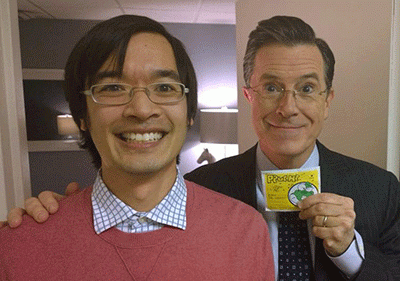
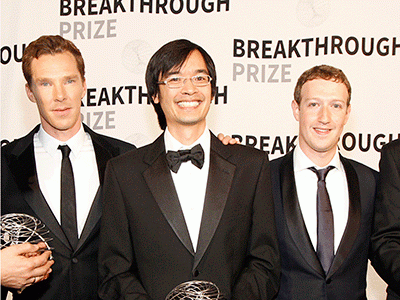
Along the way, Tao has become a little bit famous. In 2014 he was one of five mathematicians to receive $3 million each for the Breakthrough Prize in Mathematics, created by entrepreneur Yuri Milner and Facebook’s Mark Zuckerberg. Seth MacFarlane hosted the ceremony. Christina Aguilera sang “Beautiful” to an audience of technologists and celebrities that included Eddie Redmayne and Benedict Cumberbatch, who portrayed Stephen Hawking and Alan Turing *38 in movies that year.
A few days after the Breakthrough Prize ceremony, Tao was a guest on Stephen Colbert’s Comedy Central TV show “The Colbert Report.” Colbert, a bit out of his element, asked Tao what his favorite number was. Tao implied they all were great.
He keeps his eye on the bigger picture, focusing on educating students and on the unsolved puzzles that remain as we try to figure out the world. We sometimes think of math as a realm of concrete equations and iron-clad proofs. But there remain elusive mysteries. Mathematicians work for lifetimes chasing conjectures and hypotheses — beliefs that the greatest minds agree to share but can’t prove.
“It forces intellectual humility,” Tao said. “In school, we present the very small piece of mathematics that we have understood, but there’s a huge ocean of unknown mathematics. Because even the best mathematicians in the world, you can easily give them problems that they cannot solve. We’re surrounded by things that we just don’t know how to do.”
Princeton University will present its top awards for alumni to Tao and Kevin Gover ’78, under secretary for museums and culture at the Smithsonian, on Saturday, Feb. 21, 2026. The awards will be presented in Richardson Auditorium during the 111th Alumni Day ceremonies, which also will recognize student winners of the Jacobus Fellowship and the Pyne Honor Prize. The Alumni Day program will also feature the annual Alumni Association luncheon at Jadwin Gymnasium, the Service of Remembrance at the Princeton Chapel honoring members of the Princeton community whose deaths were recorded by the University in 2025, and the kickoff of the 200th anniversary of the Princeton Alumni Association. Registration is required.