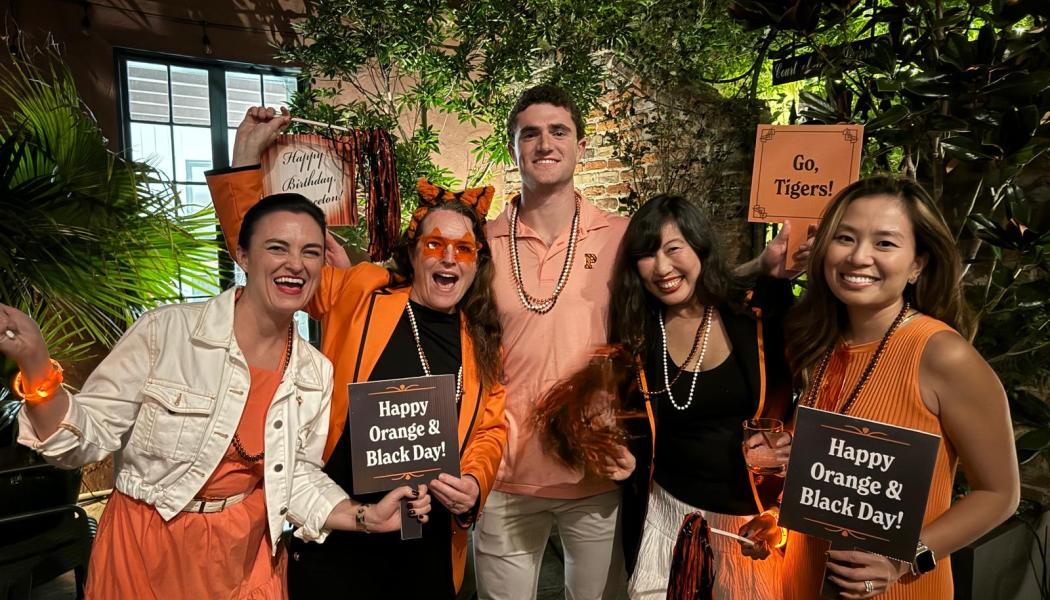
Phioto by Steven Freeman
President Christopher L. Eisgruber ’83 and Melissa Wu ’99, chief executive officer at Education Pioneers, appeared together in Boston on Dec. 3, the first of this year’s series of Forward and Beyond presidential gatherings with alumni and friends to celebrate the success of the recently concluded Venture Forward campaign and to discuss what’s next for Princeton.
Kevin Callaghan ’83, managing director of Berkshire Partners and a member of PRINCO’s board of directors, began the evening by welcoming more than 500 guests to the Fairmont Copley Plaza Hotel. “It is awesome to be here with this many Princeton-related people in one room in Boston,” he said. “Tonight, we’re celebrating the conclusion of something called Venture Forward, a remarkable campaign that involved all of us in giving, in volunteering and engaging with the Best Old Place of All.”
After a Venture Forward video, President Eisgruber and Wu took the stage. Wu began the conversation by acknowledging the success of the campaign and followed with a question about Eisgruber‘s new book, “Terms of Respect: How Colleges Get Free Speech Right.” “You don’t have a small job, and the last five years have not been the simplest,” she said. “Why was this the book that you chose to write?”
“I come to my job, first and foremost, as a scholar and a teacher. I missed the opportunity to be in the classroom; I missed the opportunity to write. One of the things I wanted to do was find the space to do some of that,” Eisgruber said.
He also said he was driven to articulate a perspective he wasn’t hearing in the national conversation around higher education. “People were saying things about what was happening on university campuses … that I didn’t think were an accurate portrait,” he said. “I felt like we were often in a reactive position at Princeton and at other universities, and it was important to be able to tell that story if we could.”
Wu cited a passage from “Terms of Respect” that addressed the relationship between free speech and equality on campus: “You say here ’to achieve deliberative community, people must not only speak freely but also respect and listen to other speakers. For that reason, deliberative community depends on commitments to both free speech and equality. The point of free speech is to get the benefit of other people’s perspectives, opinions and judgments. We can do that only if people of all backgrounds are fully included in the conversation,‘ and much of this book is about that tension. So, I’m curious for you to share with this group how you think about managing that tension, both on campus but also in the world right now.”
“As I started to write the book, the question that was most animating to me was this sense that people often treat free speech and equality as though they were competing ideals,” Eisgruber said. “I feel to my core that as a country, in the United States, we’re constitutionally committed to care both about free speech and equality — however hard that may be — and not to give up on one or the other, and I feel the same way about universities. Our mission, as that passage says, depends on people being able to speak freely and people from all backgrounds feeling that they are fully included in the conversation.”
Wu pointed out that such balance is “easier said than done,” and asked Eisgruber, who’s been president of the University for 12 years, how things have changed in this regard, for better or worse, since he began in 2013.
Princeton in Boston, Dec. 3
Photo by Steve Freeman


“We’re in a very polarized world right now, and things like supporting equality, diversity and inclusivity, which I think are fundamental to our mission, have become harder things to do — but they’ve become more important,” he said. “I also think I’ve had to learn some things in my job.”
He referred to the 2015 campus protest, in which Princeton students occupied his Nassau Hall office in order to draw attention to the divisive legacy of Woodrow Wilson. In 2020, Wilson’s name was removed from the School of Public and International Affairs and one of the residential colleges.
“I learned some things from the protests and from the issues that the students raised,” Eisgruber said. “I was learning more about Princeton’s history. I was learning about things that we hadn’t talked about — that I should have known more about — that affected the way people perceived our institution and experience going through it. I also learned more and more about what you had to do in terms of enforcing things like time, place and manner rules,” he added.
Wu followed up by placing University protest and speech guidelines in the current media landscape, “a place where speech is weaponized, where there’s various other influences, even outside of campus,” and asked how that added “more pressure and potentially more noise.”
“We have [a civic crisis] not because of something special about college campuses but because we have a civic crisis in America right now, and colleges are not exempt in any way from that civic crisis,” Eisgruber said. “I trace that civic crisis to two different kinds of phenomena: one is political polarization in the United States and the other is online media and the way it affects the way we talk to one another.”
Noting a 2024 study by Johns Hopkins University that revealed that nearly 50% of Republicans and nearly 50% of Democrats viewed the other party as “downright evil,” Eisgruber said, “It’s very hard to have a constructive conversation with somebody if you believe that that person is downright evil.”
Princeton, he said, has a role in combating such polarization and he considers the “ordinary conversations that take place” in classrooms, campus organizations and on athletic teams “the bread and butter” of a liberal arts education. In addition, he highlighted the Princeton Pre-read, an introduction to the campus experience for first-year students in which they read and discuss a selected book.
“I try to choose books for the Pre-read that have themes that are related to these issues, sometimes about social media and what happens as a result of online discourse, sometimes about free speech, but always about the ethics ... of what it is to be a constructive society and how it is we can have arguments and conversations that get at truth,” he said.
Noting the setting in Boston, which is home to an unusual concentration of institutions of higher education, Wu said, “I imagine folks are curious to hear how you feel that your ability to pursue that civic mission is today, under a presidential administration that has been antagonistic towards higher education.”
Eisgruber explained that the partnership between the U.S. government and American universities that had benefitted the nation and world for more than 70 years was currently at risk.
“The U.S. government has supported research at American universities that it — the government — deems to be in the interest of the American people,” Eisgruber said. “Over that 70-year period, both Republican and Democratic administrations, [and] both Republican and Democratic Congresses, have thought it was a good thing to invest in these research projects — that American universities have to compete for — that have enhanced our prosperity, our health and our security in this country, and it has made our universities, I would say, the best in the world.”
With the future of that relationship now in question, Eisgruber has become a prominent advocate for the importance of preserving those commitments. He noted that in May, he wrote a piece in The Atlantic that championed academic freedom and independence.
“I think that I have an obligation to speak up,” he said. “I think that we have an obligation to speak up and stand up for those principles and to say why it is that that matters so much to the country.”
“I would just say it matters so much that our alumni have been supportive around this,” he added. “I knew there was risk involved in taking that position and I will say Princetonians have rallied powerfully.”
President Eisgruber fielded questions from alumni in the audience, including Lauren Clark ’10, who asked what he felt was the University’s biggest area for improvement as it approaches its 300th anniversary in 2046.
“We’ve begun to think more about how is it that we can make a difference within our region, and how is it that we can, for example, connect to and support community colleges,” he said.
He also pointed to the revitalized transfer program, which has enabled more than 100 community college students and military veterans to come to Princeton, including Hadi Kamara ’25, who recently was named a Rhodes Scholar.
“When I go down to Washington and talk about what we’re doing, and all of a sudden they find out that some of the people who are on the Princeton campus are community college transfers, that we have worked hard to increase the number of veterans, that makes a difference to how people see Princeton University,” he said.
With the final audience question, an alum asked if the University’s free speech policy extended to damaging speech that was counterfactual.
“We recognize that speech can be very harmful. When people say, ‘Sticks and stones can break my bones, but words will never hurt me — well, that’s ridiculous, right?” Eisgruber said. “It’s not that words don’t hurt people; it’s that censorship is a very bad thing to have happening on a college campus or in a country, and it’s really important for people to be able to speak. … We think it’s the right thing to do to give people tremendous freedom, and then we think the important thing to do is to educate our students and create a kind of civic community.”
After President Eisgruber thanked the audience for attending, Callaghan provided closing remarks supporting his classmate’s stewardship of the University. Callaghan then introduced Brit Katrina Dewey ’90 and Tina Dockstader Kinard ’84, who stepped forward to lead the audience in the singing of “Old Nassau.”
Additional photos from the Boston event can be viewed here.