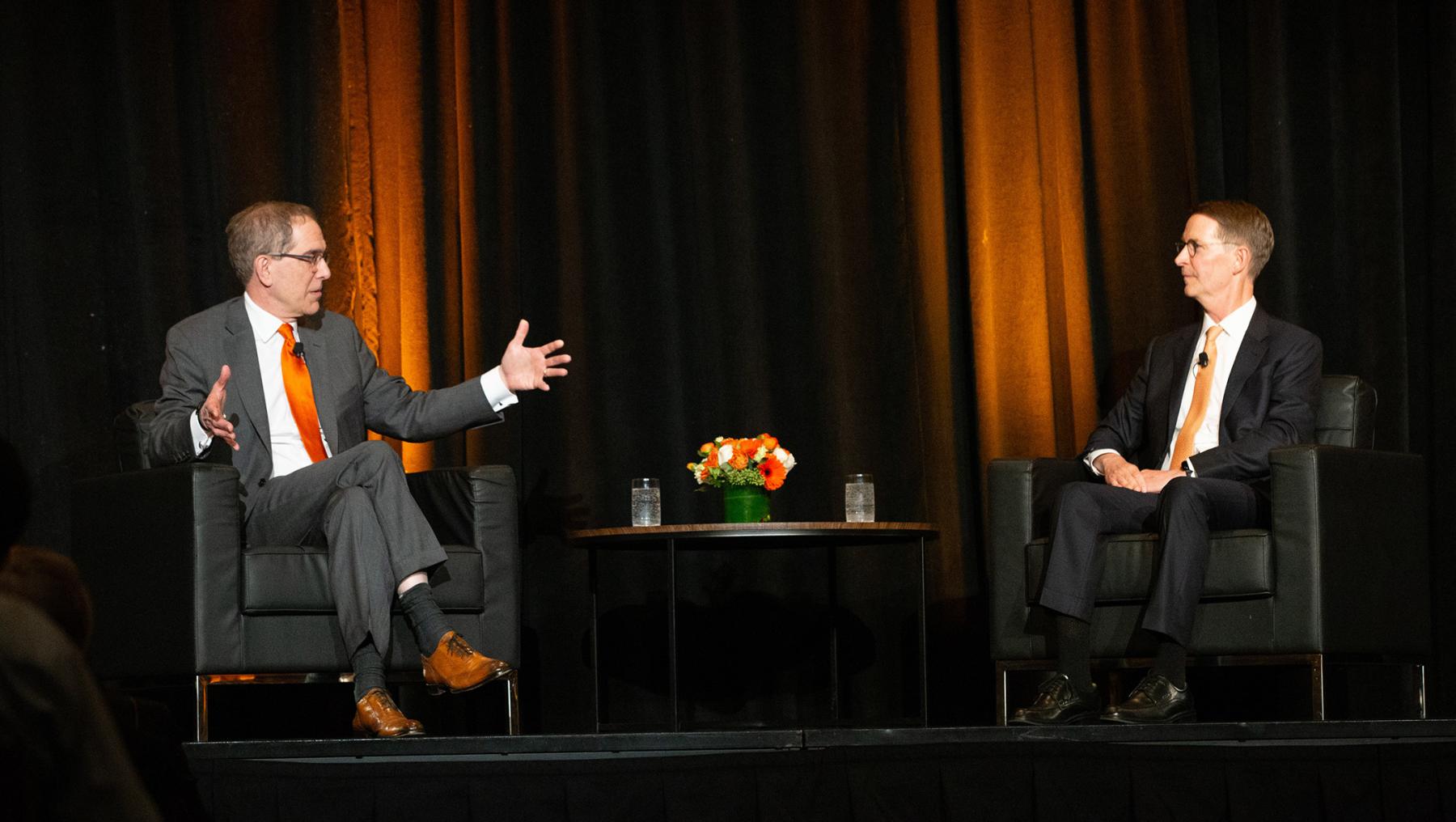
President Christopher L. Eisgruber ’83 and Mason Morfit ’97 at the InterContinental Los Angeles Downtown. Photo by Jenny Stein
President Eisgruber addresses alumni and friends at two Forward and Beyond events in California
President Christopher L. Eisgruber ’83 met with alumni and friends at two Forward and Beyond gatherings in California, thanking the Princeton community for their tremendous impact in the successful Venture Forward campaign and sharing updates about what’s next for the University.
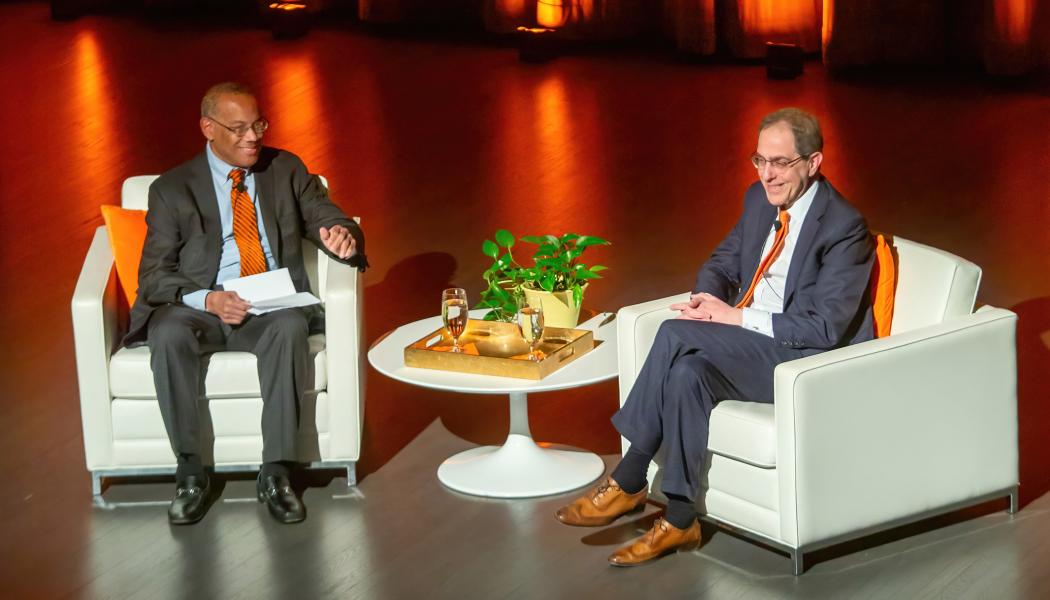
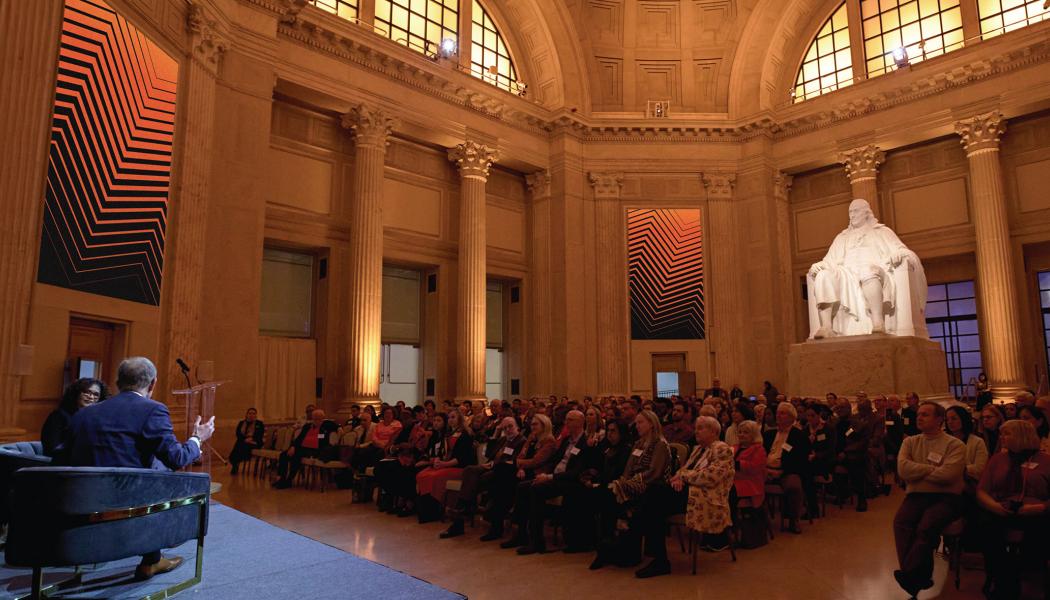
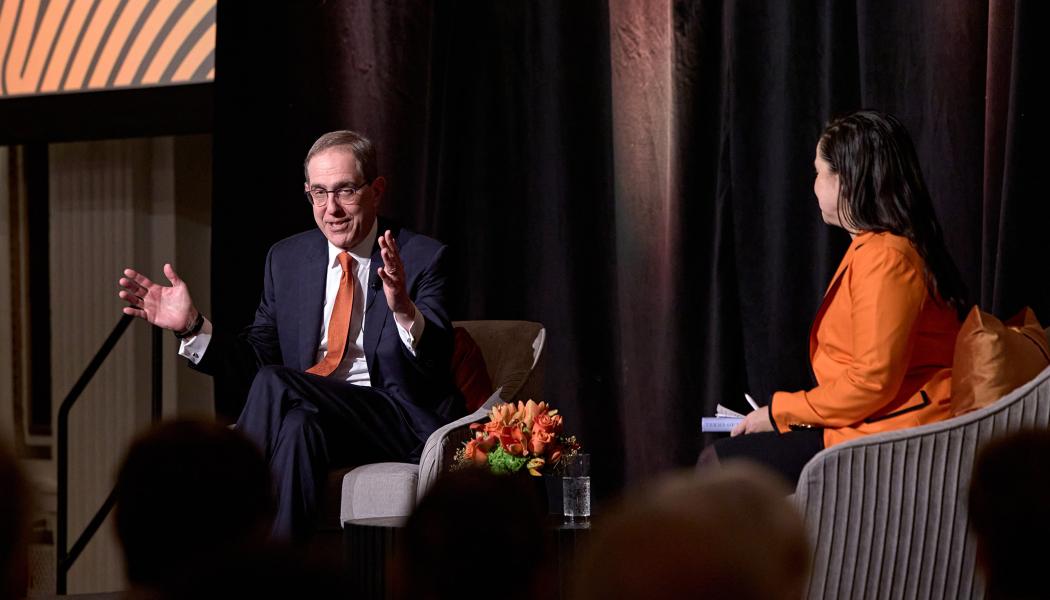
In San Francisco on March 10, Eisgruber spoke with Bob Peck ’88, University trustee and managing director of the Fremont Group, in front of an audience of more than 700 alumni and friends at the Westin St. Francis. Among other topics, they discussed the transformative impact of the Venture Forward campaign; themes from Eisgruber’s recent book, “Terms of Respect: How Colleges Get Free Speech Right”; challenges created by the federal government’s recalibration of its relationships with research universities; and the promise and concerns of new technologies related to artificial intelligence.
Two days later in Los Angeles, more than 325 alumni and friends were in attendance as Mason Morfit ’97, co-chief executive officer of ValueAct Capital, talked onstage with Eisgruber at the InterContinental Los Angeles Downtown. Their conversation addressed Eisgruber’s most recent State of the University letter, the lessons he has learned from other university presidents who led through turbulent times, and Princeton’s abiding commitment to diversity and inclusion.
In San Francisco, April Chou ’96, vice president of the Alumni Association and vice chair of the Alumni Council, welcomed the audience: “This is a really special year to be a Tiger, because not only did we just complete an incredibly successful campaign, but it is also the 200th anniversary of the Alumni Association.”
In Los Angeles, Nathalie Choi ’96 opened the evening. “Together, we’ve just completed Venture Forward, a remarkable campaign that involved us all in giving, volunteering and engaging with the Best Old Place of All,” Choi said. “We’re here tonight to celebrate that achievement, to enjoy reconnecting with one another and to hear what will come next as we venture Forward and Beyond.”
The West Coast all-alumni events were part of this season’s Forward and Beyond tour that also brought Eisgruber to Boston in December and Chicago in January. The next gathering will be held in New York City on April 16.
Here are some of the top takeaways from the San Francisco and Los Angeles events:
In San Francisco, Peck invited Eisgruber to give a figurative “stroll through campus,” to highlight some of the new construction that has transformed Princeton as a result of the Venture Forward campaign. Eisgruber remarked that any tour of campus, real or imagined, would note that the campus has expanded since the beginning of the campaign because two new residential colleges and enhanced financial aid have allowed the University to grow by 500 undergraduate students.
“We say no to many students every year who are just as qualified as the students at Princeton, so being able to say yes a bit more often was extraordinarily important to me as I became president,” he said. “It’s one of the things that the campaign made possible.”
Eisgruber described the new Princeton University Art Museum, the Class of 1986 Fitness and Wellness Center, the under-construction Hobson College, the Frist Health Center, Briger Hall and the new engineering buildings on Ivy Lane, Eric and Wendy Schmidt Hall — a renovated Guyot Hall that will become the new home of the computer science department — and the Meadows Apartments graduate student housing neighborhood across Lake Carnegie.
“When I walk around campus, I see the effects of the Venture Forward campaign. And what I know in my heart is that all of those changes that we’ve been able to accomplish — and the ways that we’ve preserved the core of what has made Princeton special — is down to the best alumni body in the world.”
Peck asked Eisgruber about his decision to dedicate “Terms of Respect” to his students. “People talk about students as being snowflakes or being weak or not being interested in confronting ideas different than their own, and that’s not what I was encountering on the Princeton campus,” he said. “So, part of what I wanted to do was just to tell the world: I have a lot of respect and admiration for the generation of students who are on university campuses today, and I want to describe what it is that [happens] on those campuses and why I feel that way about our students.”
Peck mentioned recent attempts by the federal government to leverage research funding as a means of seeking influence and policy changes on American campuses. “Can you tell us what you would have us know about the challenges that have come as they relate to federal government funding?” he asked.
Eisgruber explained the mutually beneficial government/university relationship that evolved after World War II, in which the government has funded research “to spur the kind of innovation and discovery that makes a difference to the country.”
“At the same time, it has respected academic freedom,” he continued. “It has respected, in other words, the right and responsibility of scholars to pursue truth and understanding and knowledge on the basis of their scholarly judgments and not according to the whims of somebody who’s in power. That’s what academic freedom is all about.”
Eisgruber noted that he has redoubled his focus on meeting with elected leaders in Washington, D.C. “We need to stand up for academic freedom, and we need to stand up for the quality of our universities,” said Eisgruber, who described the Stand Up for Princeton campaign and encouraged alumni to advocate for higher education. “There are people [in Washington] who understand that appeal, but it matters if they hear it from their constituents. If you’re willing, if you agree with me, please stand up for Princeton and stand up for higher education.”
With his last question, Peck asked about the challenges and opportunities that artificial intelligence presents to Princeton’s mission of excellence. In the classroom, Eisgruber noted, some professors have revamped their methods for assessing student performance by resurrecting blue books and oral exams.
On the other hand, Eisgruber said, AI enables scholars to conduct research that was previously thought impossible. “At the same time it’s disrupting reading habits, it’s also enabling humanities scholars to ask questions about literary texts that they could not previously ask.”
In Los Angeles, Morfit began the conversation by asking about the president’s recent State of the University letter, titled “From Growth to Focus.” Eisgruber noted that changing market conditions have made it unlikely that Princeton’s outstanding investment team will be able to secure endowment returns as high as those that the University has enjoyed over the past three decades. “We should feel good about what it means to be at Princeton, but we’re going to have to be very focused on what our key priorities are,” he said. “We’re sometimes going to have to grow through substitution rather than growth.”
Morfit followed with a question about the impact of the federal government’s disruption of university research funds, inviting Eisgruber to join him in a “time machine” traveling back to a different era on college campuses: the 1960s. Both Morfit and Eisgruber said that they have read extensively about the university leaders who weathered the social and political storms of that era, notably Clark Kerr, who was president of California’s state university system before being fired in 1967 by its board of regents under pressure from Gov. Ronald Reagan. Eisgruber told the audience that he began reading histories of Kerr and other notable college presidents as protests took place on college campuses, including Princeton’s, in 2023.
“You have to realize that there were really good people in the past who I think did everything about as well as they could, and sometimes it worked out [for them], sometimes it didn’t. But the good news is those institutions persisted,” he said. “I look at the tough choices that folks like Kingman Brewster, whom I also admire at Yale, and Robert Goheen, whom I admire at Princeton, had to make. Part of what they had to do was lead with values as they moved forward, recognizing that circumstances were going to be really hard, but you have to know what your North Stars are, and you have to let them guide you.”
April Chou ‘96 in San Francisco


Morfit asked about Eisgruber’s March 2025 article in The Atlantic that advocated for the American university system. “I felt like I needed to speak up at that point because those were the principles that I thought were constitutive of these institutions to which I had dedicated my life,” Eisgruber said.
His concerns for potential criticism from the Princeton community for speaking out were quickly eased. “I started getting [supportive] letters from groups of faculty in one department after another … I heard from our alumni. I heard from our students,” he said. “There are these fundamental principles that unite us. This is what it is to be part of a university. We disagree about lots of things, but people believe in excellent research and its ability to change society for the better and in the importance of academic freedom.”
The conversations in both cities were followed by Q&A sessions; audience members asked questions about such topics as achieving a diverse student population in light of court rulings, the status of specific labs and University partnerships following research funding cuts, and the University’s commitment to free speech and inclusivity.
Both Forward and Beyond events concluded with singing of “Old Nassau,” led in San Francisco by Karen Roter Davis ’94 and in Los Angeles by Tina Treadwell ’80 and Zach Lee ’26, followed by lively receptions that allowed alumni to connect, converse, get their copies of “Terms of Respect” signed by the president and take photos at a Stand Up photo station.
The Venture Forward campaign was a mission-driven campaign that focused on Princeton University’s strengths in the liberal arts, pushing the boundaries of knowledge across disciplines, and collaborating to champion inclusion, the humanities, science, art, public policy and technology. The campaign had three areas of impact: deepening engagement of Princeton’s alumni community; providing a platform to communicate Princeton’s service to humanity and its vision for the future; and securing philanthropic support for the University’s strategic initiatives.