Katherine Boyce ’11 adds to the joyous Reunions hoopla with a painting that celebrates tradition and change

Courtesy of Katherine Boyce.
The Princeton campus has felt like home to Katherine Boyce ’11 for as long as she can remember. Her parents, both members of the Great Class of ’79, returned to the University not long after their graduation to serve as leaders of Princeton Christian Fellowship, a ministry for students on campus.
“I had such an idyllic childhood,” Boyce said. She and her three siblings “grew up in walking distance from the University where our parents had met. They were chaplains for the University for many years. And man, we were lucky. We had a great time with the University connection that my parents had relationally and communally.”
Reunions were a special time. “It was kind of a family reunion. I love all the hoopla around Reunions.”
Now an artist based in Minneapolis, Boyce was invited to create a painting for the cover of the events program for Reunions 2026. She chose a view of campus with meaning from her years as an undergraduate. “I watched this spot a thousand times as a student,” she said.
Boyce’s landscape painting captures both permanence and change — from a peek at the new Princeton University Art Museum on the right, through the space between Whig and Clio Halls and onward to Nassau Hall. The work, created in oils, also includes banners celebrating the Alumni Association’s 200th anniversary and tells the story of a University rooted in history yet continually evolving.
Boyce walked this path often as a student, both as a resident of Dod Hall and as member of Brown Food Cooperative, the independent dining option where members prepare meals together in Brown Hall’s kitchen. “Some of the best dinnertime conversations I’ve ever had were at Brown Co-op,” she said.
Her choice for the landscape was also influenced by a visit to the new art museum soon after it opened last fall. “I was just giddy inside the museum, looking out from the completely new perspective of this really extraordinary building at things on campus I have seen my entire life,” she said.
“I love when things change in a place, but they’re in a kind of harmony with things that are preexisting or older.”
Boyce’s interest in painting began at Princeton in studio art classes. While she was a politics major with a focus on international relations, she also pursued a certificate in visual arts. She loved creating in the Lewis Center for the Arts studios at 185 Nassau.
After Princeton, Boyce traveled with Princeton in Asia to Singapore, where she taught writing for two years. In 2014, she moved to Minneapolis to work for a communications consultancy. Five years later, she began painting full-time. “Minneapolis has a really wonderful arts community,” she said. “In the arts district where my studio is, there are hundreds of artists within a very small distance of each other.”
Boyce says her art focuses on “the spaces we build and inhabit and impact as humans.” As an environmentalist and an urbanist, she is equally interested in exploring natural and built environments. In her artist’s statement, she wrote, “My paintings blend representational forms with semi-abstraction to evoke a sense of impermanence and memory.”
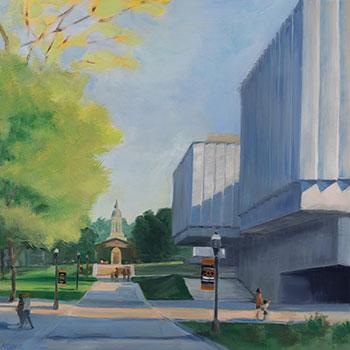
It’s an approach that aligns well with the 200th anniversary of the Alumni Association. While her own memories inform the campus landscape she’s captured in the cover art, the view has also captivated the imaginations of generations of Tigers, including her parents, two of her grandparents and two of her great-grandparents — Edwin Baldwin ’1924, on her mother’s side of the family, and Robert Boyce ’1898.
When Robert Boyce arrived as a freshman, the newest buildings on campus included Brown Hall (1891), Dod Hall (1890), Whig Hall (1893) and Clio Hall (1893) — joining Nassau Hall (1756) as the landmarks easily spotted from this same vantage point, just as they still are.
More than a century separates her great-grandfather Boyce’s Princeton experience from her own, and while many iconic buildings remain, the campus has also changed tremendously, growing and evolving with the times. The Venture Forward campaign has transformed campus in recent years, with the addition of many state-of-the-art buildings and facilities, including the art museum — each part of the ongoing story of a place that so many have called home.
Boyce’s painting holds it all at once — memory and change, past and present — in a joyful celebration of a beloved campus view.


