Science meets art: Marisa Goldenberg ’98 brings creative leadership to her new Alumni Council role

Photo by Andrea Kane
When Marisa Goldenberg ’98 enrolled in Adam Finkelstein’s computer graphics class at Princeton, she remembers marveling at what was, at the time, cutting-edge 3D-modeling technology: “I thought it was so amazing that we could create a sphere!”
The computer science major pursued independent study with Finkelstein, the Phillip Y. Goldman ’86 Professor in Computer Science. With his guidance, she developed a computer program that could create a digital work of art: a large mosaic image composed of smaller images, as tiles. Her spring junior paper resulted in an image of Blair Arch, shown below, composed of 250 scenes of the campus and produced as a commemorative poster for the University’s 250th birthday in 1996.
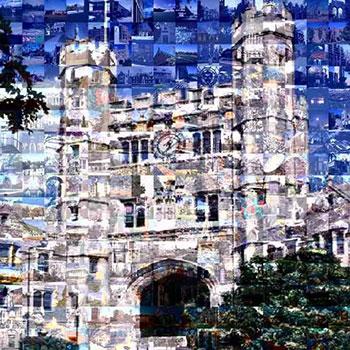
The experience opened her eyes to the intersection of science and art, which has been a hallmark of her professional and volunteer work, including her new role as Alumni Council assistant treasurer. “Some people think leadership and management are a science, and others think they’re an art, but I think they’re absolutely both science and art,” Goldenberg said. Her most enjoyable professional roles, she explains, have been ones where she combined “disciplined operational execution with the human creativity of my team.”
After graduation, Goldenberg moved to Austin to join Trilogy Software, a breakout company of the late 1990s. She also launched a side business creating custom artwork using her mosaic software. It was the beginning of a successful career in enterprise technology that included nearly a decade at Dell, where she served as director of global business operations, and a variety of C-suite roles at other companies, including CEO of a private equity portfolio of software companies, founding operating partner of a private equity firm and COO of a nonprofit rideshare company. Along the way, she earned her MBA at Harvard Business School. Currently, Goldenberg works as a management consultant and is CEO of a startup that is developing software that uses AI to help travelers generate journals based on the photos they take.
As a volunteer for Princeton, Goldenberg has applied her “art and science” leadership philosophy to great effect. In 2020, she became an ambassador for the Alumni Schools Committee, which led her to connect with the Princeton Club of Austin (PCA). The timing was fortuitous, as the demands of her career had become somewhat less time-consuming. She became treasurer of PCA and then, from 2021 to 2025, served as the club’s president. As president she led a team of volunteers who expanded the growing club by offering a wide slate of events, enhancing the club’s communications and creating new opportunities for connection, including a mentorship program.
With her analytic skills, Goldenberg said she “focused on strengthening the club’s internal operational infrastructure and tools, as well as leveraging data to measure and track continued progress on various metrics.” With her artistic talents, she has produced custom projects such as wineglasses and coasters with PCA’s logo to reward and inspire the club’s volunteers and sponsors.
As PCA president she became a member of the Alumni Council, the Alumni Association’s governing body, and her service to Princeton expanded. In 2022 she was elected to the Alumni Council Executive Committee (ACEC) as a regional association officer serving on the Committee on Regional Associations (CORA) for a two-year-term, during which she hosted presentations that shared PCA’s best practices with other clubs. In 2024, Monica Moore Thompson ‘89, then president of the Alumni Association and chair of the Alumni Council, invited Goldenberg to the ACEC as an at-large member and she served on its Composition Working Group. From 2023 to 2025, Goldenberg was also a member of the council’s Communications and Technology Committee. The Alumni Council work energizes her. “Everyone is so passionate about giving back to the University,” she said. “It’s so fun to meet enthusiastic Tigers of all generations and people who are in different careers.”
Goldenberg credits her parents for creating an early example for her of why volunteering matters and why it’s important to “think bigger about the world and how you can make an impact.” Her father was born in Europe and her mother’s heritage is Mexican. The family traveled often when she was young, visiting relatives and renting homes “long before Airbnbs,” which allowed them to experience the daily life of many cultures.
Goldenberg has visited about 52 countries, and she and her husband have traveled widely with their now-teenage son, hoping to help him develop an appreciation for “different religions, different cultures, different traditions and the diversity of the world.” In many ways, she said, that’s also the allure of “coming back into the Princeton fold as an alumni volunteer.”
Now, as part of the Alumni Council’s new leadership team that began their work in July, she’s eager to help more Princetonians connect with the University for the Alumni Association’s 200th anniversary in 2026. For Goldenberg, the Alumni Council leadership’s theme — “Our Princeton. Our time.”— means “recognizing the diversity of our alumni community, which will come together to celebrate past traditions and create new ones. When you bring us all together, you can achieve a lot more and really do some amazing things.”
For her part, Goldenberg is already bringing both her analytic talents and creative skills to strategic leadership planning conversations and to her role on the Alumni Council’s ad hoc committee to celebrate the 200th anniversary. She is creating a process for Alumni Council funding to be available to alumni groups to drive engagement around the anniversary and is working on a yet-to-be-announced project that will encourage alumni to show their own creative stripes. “Everyone has unique skills and unique ideas about what makes Princeton special,” Goldenberg said. “We each connect with Princeton in a different way, but we share that common bond.”
In some ways, her leadership in helping unite Tigers through the Alumni Association mirrors her independent work at Princeton: Individual alums are the independent, unique tiles, and the Alumni Association is the mosaic created when they’re brought together, becoming something more than the sum of their parts.


