Photos by Steven Freeman
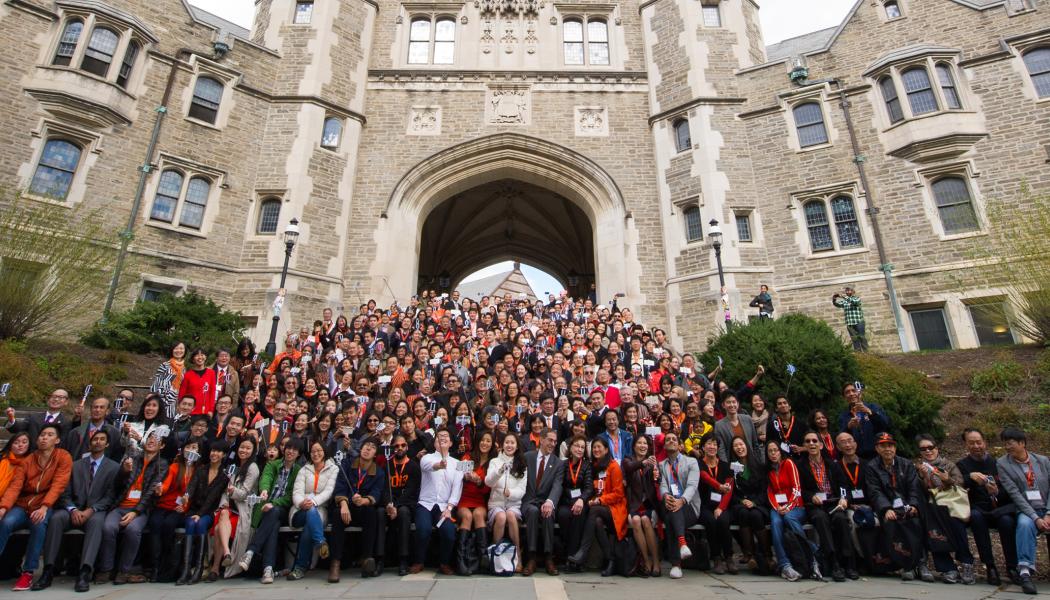
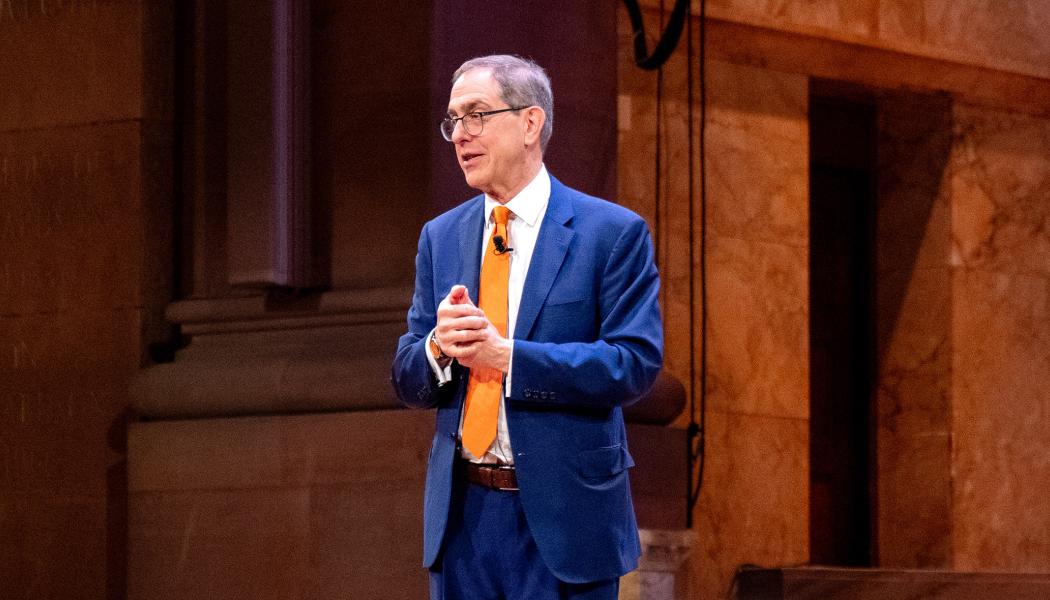
President Christopher L. Eisgruber ’83 met with alumni and friends in New York City on April 16 for the final Forward and Beyond all-alumni event before Reunions. In the on-stage conversation with Louise “Weezie” Sams ’79, chair of the Princeton University Board of Trustees, President Eisgruber expressed gratitude to the more than 850 guests for their attendance and support, reflected on the success of the recently concluded Venture Forward campaign and shared perspectives about what’s next for Princeton.
From the podium at the New York Marriott Marquis, Eric Plummer ’10, treasurer of the Alumni Association, welcomed the Princeton audience and thanked them for their engagement in Venture Forward. “We’re here tonight to celebrate that achievement and to enjoy reconnecting with one another and to hear what will be coming next as we venture Forward and Beyond,” he said. “This is a really big year to be a Tiger, because not only did we just complete an incredibly successful campaign, but it is our 200th anniversary of the Alumni Association.”
Following a Forward and Beyond video highlighting the transformative changes made possible by alumni and friends, Sams pointed out that the blueprint for Venture Forward was the strategic framework that the University adopted in 2016, shortly after Eisgruber became president. She asked him about his rationale for the strategic process and his assessment of its success.
“I felt as we made decisions, it was really important to have an understanding both of the principles that were guiding us and of the opportunities that we might be passing by,” said Eisgruber, who credited members of the Board of Trustees for suggesting the strategic project. “If you go back and read the short 25-page framework, you’ll see something that captures the aspirations of the University at the time, and particularly if you look at it together with the campus plan, you’ll see something that describes the Princeton University campus as it is today. [It] laid out what we were trying to achieve and how it might be reflected on the campus.”
“We talked about important goals of the Venture Forward campaign, like increasing socioeconomic diversity, adding to the size of the undergraduate student body, reinforcing our commitment to the liberal arts and to leadership in the humanities, dealing with the effects of the information age and how that was changing the world of universities. It was a lot of work at the time we did it, but I think the reason that we’ve been able to make the progress that we did is because we took the time to think about where we wanted to go.”
When Sams asked Eisgruber to highlight some of the major impacts of that strategic framework and Venture Forward, he quickly focused on the impact on human potential. “The heart of Princeton University are the people who come through it,” he said. “One of the foremost goals that we had as we went into the campaign is that we were going to expand the undergraduate student body. I think all of the things being equal, more Princetonians is better than fewer Princetonians. And we’ve been able to say yes to 125 more students per year and bring them onto our campus and then support them.”
None of this would have been possible without the support of alumni and friends who contributed to Venture Forward through Annual Giving, scholarship support and major gifts, President Eisgruber quickly added. “Thanks again to the generosity of all of you and the commitment of Princetonians to affordability and access, we have the best financial aid program in the country,” he said. “We have roughly 70% of our incoming students on aid that is best-in-class by a fair distance.”
He also pointed to the significant increases, through Venture Forward, to graduate student stipends and fellowships, as well as the added professorships that have boosted a faculty that is second to none in teaching and research.
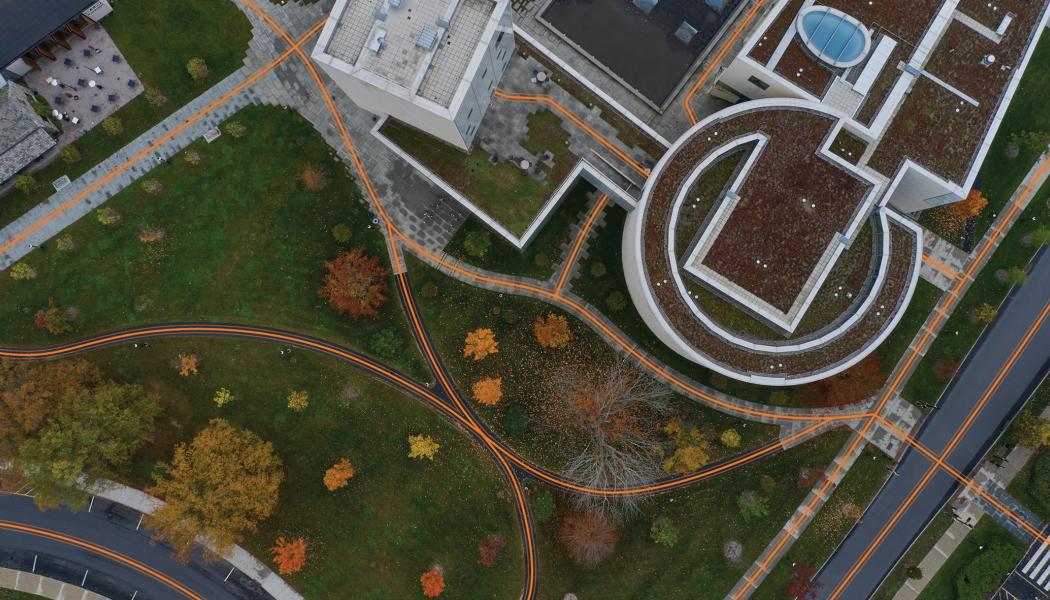
The campaign also transformed the campus, President Eisgruber noted, listing a few major construction projects that have transformed the campus during Venture Forward: new graduate student housing and athletic complexes on the other side of Lake Carnegie; a new complex of buildings for engineering and the environmental sciences on Ivy Lane, including Briger Hall and the Sarofim Pavilion; the Class of 1986 Fitness Center and the Frist Health Center; and the reimagined Princeton University Art Museum.
“[The new art museum] is an extraordinary place where I believe every student who comes to our campus — every person who comes to our campus — is going to look at that building and say, ‘I want to go in there.’ And once they’re in, they are going to be captivated by the arts and the humanities in a way that would not otherwise have happened.”
Princeton in New York City, April 16
Photos by Steven Freeman


Sams then asked about Eisgruber’s book, “Terms of Respect: How Colleges Get Free Speech Right.” “You started working on this book several years ago, but then when it was published in September, it seemed as though you had almost anticipated some of the fraught times that we’re in,” she said. “What initially motivated you to write the book?”
“I was motivated because we were dealing with a series of incidents and episodes on campuses, including our own, that involve free speech and diversity,” he said. “People were putting those two values, which I think are fundamental to this country and fundamental to universities, at odds with each other in a way that I thought was a mistake.”
“We shouldn’t be censoring speech based on its content; at the same time, we should be looking for ways to support talent and make sure that we are achieving the kinds of diversity and inclusivity that are critical to our Constitution and critical to what it is universities do,” he added. “The point of the book is to be able to say, ‘Look, we should care about free speech, but we should care about it in a way where we also care about diversity and inclusion.’”
“There are some people who would say, ‘Oh, well, maybe every first-year student should have a civics class,’” Sams said as a follow-up. “Is that the right answer?”
“I think everything we do in the liberal arts curriculum is designed to educate students around civics,” Eisgruber said. “It’s not so much a matter of teaching the rules. It’s a matter of exemplifying ways of having respectful discussions that ought to occur, and I think it does occur in just about every seminar and precept and class that takes place at a university like Princeton.”
Sams noted that Eisgruber is spending a significant amount of time in Washington, D.C., meeting with elected leaders to emphasize the importance of higher education and the unique partnership universities have with the federal government. “Do they not appreciate the partnership between the federal government and universities in research, and if not, what are their biggest issues with universities?” she asked.
“At a foundational level actually, there is really widespread agreement about the importance of that partnership. It doesn’t mean that the partnership is not in jeopardy,” he said, noting areas of shared focus such as quantum science, fusion energy and artificial intelligence. “You see initiatives coming from the administration in those areas that depend on this critical partnership.”
Progress is being made on preserving the partnership, but there are certain issues that should not be part of any negotiation with the federal government, said Eisgruber. “When it comes to academic freedom, I think it is the responsibility of every university — and I think it’s the responsibility of citizens — to say academic freedom is essential to what it is universities do. And we can’t compromise on that.”
Before opening the floor to audience questions, Sams asked Eisgruber about the impact of artificial intelligence on campus. “I think this is the most profound question as we look forward at the future of the University,” he said. “How do we seize the opportunities that artificial intelligence presents to us, and how do we adjust for the risks that it poses to learning, including the core of the liberal arts model?”
Those opportunities are extraordinary and undeniable. “The sorts of things that we can do because we can now look at data and pose questions that we never did before are amazing,” Eisgruber said, citing examples in astrophysics, biology, neuroscience and the humanities.
He also noted that this year’s Pre-read for the Class of 2030 is “Reader, Come Home: The Reading Brain in a Digital World” by Maryanne Wolf. “It’s about how we read in a digital age, what we can get from digital media and how we preserve the experience of going deep in a book,” he said. “Because I don’t think we can preserve the kind of learning that is so critical to the Princeton experience, the formation of minds and the formation of citizens, unless we preserve that kind of deep contemplative experience that comes from immersive reading. For me, that’s the biggest challenge.”
During the Q&A period, Eisgruber fielded questions from alumni in the audience, including one who asked what the University is doing to ensure continuity of ongoing research projects whose funding has been threatened or cut by the federal government. He noted that the political headwinds were compounded by expectations that endowment returns, though still strong, will be lower than the University has seen for the last 30 years.
“Part of what we’ve done is to create a strategy that says, ‘All right, we’re going to find ways to operate more efficiently across this campus,’” said Eisgruber, who announced a move “from growth to focus” in his most recent State of the University letter, “and then we’re going to work together with faculty members and department chairs to put in place funding that will get us from where we were before to where we need to be.”
Another member of the audience asked Eisgruber about the future of the endowment tax that currently impacts Princeton and other universities. He provided background on university endowments, and how the relationship between universities and the federal government shifted in 2017 when a tax was initiated.
“That is an area where we have to continue to be advocates for reducing that tax and explaining why it is that endowments make a difference to our universities and work for the public good,” he said. “We spend [from the endowment] in order to make Princeton one of the most affordable universities in the country and to do the research that the government wants us to do, and if the government continues to tax that endowment, it is a tax on the affordability of a college education and it is a tax on research that makes a difference for our future.”
With the final question, an alumnus asked about the future of the Honor Code and the potential for proctored classroom exams. Eisgruber clarified that there was no discussion to abandon the Honor Code, but that adjustments — including proctored exams — are being discussed because current technology has made it more difficult to identify, enforce and report students who might violate it during exams.
“One of the things that makes me so excited to be president of Princeton University is that I love our students,” he said. “I think the students who are on our campus today are inspiring students with strong values and public-spirited motivations. They are attending college in times that are much more fraught, both technologically and politically, than when I went to college.”
“They deal with a different set of challenges, and I think I and others who lead the institution need to recognize this. But I will say this: I believe that our students today continue to have a commitment to the values of the Honor Code as they did in the past, and that’s true regardless of which way we come out on this pragmatic debate about whether to add proctors.”
After President Eisgruber thanked Sams and the audience for the conversation, Plummer returned to the stage to introduce Kat Giordano ’18 and Benny Wagstaff ’14, who stepped forward to lead the audience in the traditional singing of “Old Nassau.”
A reception followed the event, and President Eisgruber signed copies of his book for alumni and guests.
Additional photos from the New York event can be viewed here.